Alzheimer’s disease target and drug discovery by leveraging multiomics and electronic health data
Observational causal inference on healthcare data to support a GWAS-based Mendelian Randomization nominating potential drug targets for Alzheimer’s disease.
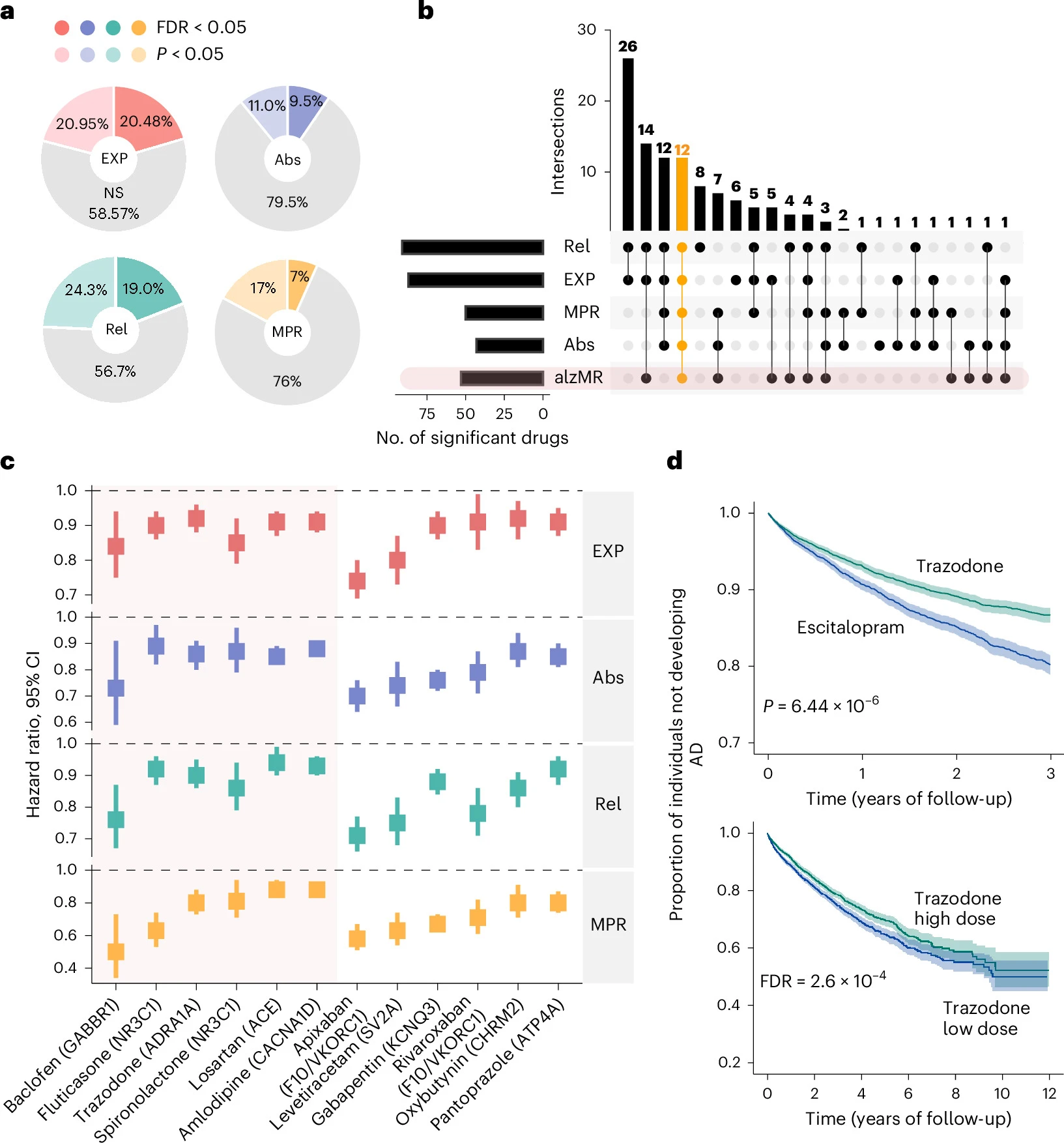
Despite prolific genomic data from individuals with Alzheimer’s disease (AD), translation into treatments has lagged. Here we applied Mendelian randomization to multiple AD genome-wide association studies and functional multiomics datasets to nominate druggable targets, identifying 19 targets for individuals of European ancestry and 7 for African ancestry. This included epoxide hydrolase 2 (EPHX2), for which we identified a protective missense variant (p.Arg287Gln). Experiments in induced pluripotent stem cell-derived neurons and cerebral organoids from patients with AD validated the protective role of p.Arg287Gln via reduced levels of EPHX2 and phosphorylated tau (pTau-181). Pharmacological inhibition of EPHX2 improved cognitive performance in the 5xFAD mouse model of AD. Finally, by leveraging electronic health data from 111,680 patients with mild cognitive impairment, we identified 12 drugs associated with reduced AD incidence, including trazodone (targeting ADRA1A) and baclofen (targeting GABBR1). Thus, integrating multiomics data, functional validation and electronic health data identifies new approaches for treating AD.
Citation
@article{hou2026alzheimer,
author={Hou, Yuan and Li, Yichen and Zhang, Pengyue and Lorincz-Comi, Noah and Gohel, Dhruv and Fan, Fan and Qiu, Yunguang and Yang, Jun and Chen, Xin and Song, Wenqiang and Yang, Xiaoyu and Tan, Zhibing and Liu, Zhigang and Fang, Xing and Rivera Paz, Isabela and Martin, William and Feng, Yayan and Zhou, Yadi and Xu, Jielin and Dou, Lijun and Border, Jane and Zhang, Huawei and Mazique, Jena' N. and Hwang, Sung Hee and Roman, Richard J. and Babak, Tousi and Bekris, Lynn and Karavani, Ehud and Danziger, Michael and Rosen-Zvi, Michal and Haines, Jonathan L. and Yu, Haiyuan and Hammock, Bruce D. and Leverenz, James B. and Pieper, Andrew A. and Cummings, Jeffrey and Cheng, Feixiong},
title={Alzheimer's disease target and drug discovery by leveraging multiomics and electronic health data},
journal={Nature Neuroscience},
year={2026},
month={Oct},
day={08},
publisher={Nature Publishing Group US New York},
issn={1546-1726},
doi={10.1038/s41593-026-02472-0},
url={https://doi.org/10.1038/s41593-026-02472-0}
}